

Comparing the Cost of Wildflower Seed to Lawn Grass Seed

Question: Why is wildflower seed so much more expensive than lawn grass seed? Answer: It’s not! When figured on a per-unit-area basis, the cost of wildflower seed and lawn grass seed is very comparable. Depending on the species used, wildflowers can be even less expensive than grass seed. Here’s the deal—it is like comparing apples and oranges, in a way. Actually, it is like comparing bb’s to bowling balls. Grass seed, like fescue, is relatively large compared to many types of wildflower seeds. One pound of tall fescue seed contains 227,000 seeds. Many wildflower species have tiny seeds—showy evening primrose has over 3 million seeds per pound, and cardinal flower has 8 million seeds per pound! So a small amount of seed goes a long way. It is the number of seeds that is important, not the weight or the size. That is one reason why we say it is like apples to oranges. The bottom line is this: you have a particular area that you would like to convert to wildflowers or to a native grass/wildflower meadow. How much would it cost for this compared to just seeding lawn grass? The key is in the seeding rate; that is, how much seed per unit area do I apply? Wildflower mixes can cost considerably more per pound than lawn or pasture grasses, but the seeding rate is much lower, so you need considerably fewer pounds. Picture a football field: if you started at one goal line seeding at a moderate rate for lawn grass (9 lbs/1,000 sq ft) from sideline to sideline, a 20-lb bag of grass seed would only last until just past the 4 yard line (the yellow zone below). You barely got out of the end zone!So, the cost per pound is not the whole story—the real cost of seeding is the price per pound for seed AND the seeding rate. Taken together, wildflower seeding is comparable, or sometimes cheaper, than seeding turf grasses. Here’s a real-life example: I checked prices on-line for Rebel Tall Fescue and found that it cost an average of $50 for a 20-lb bag; that’s $2.50 per pound. Yep, that’s pretty cheap. But you have to put a LOT of that seed out to get a lawn—7 to 10 pounds of it per thousand square feet of area. At $2.50 per pound times 9 pounds, that is $22.50 per thousand square feet for lawn-type tall fescue. The finer turf-grass blends costs more like $4.00 per pound, or $36.00 per thousand sq. ft. The pasture-type tall fescue variety, Kentucky-31, is a similar price to Rebel Tall Fescue and can be sown at a lower rate, but that’s what you get—clumpy, wide-blade pasture grass. Let’s say you have a one-third acre (= 14,520 sq. ft.) plot of ground that you don’t know what to do with, or that you are tired of mowing continually. Or a right-of-way area recently disturbed by the utility company. You could plant that one-third acre in turf grass for a seed cost of about $330 at a moderate seeding rate of 9 lbs/1,000 sq. ft. The nicer turf grass blends will cost you well over $500. insert photo of someone mowing a big grassy area With our Eastern Native Habitat Seed Mix, at ¼ pound/1,000 sq. ft., you could plant the same area for $165—exactly half the total cost of the cheapest grass seed. And you mow a couple of times per year, or not mow at all if you like. Yes, the Habitat Mix costs over $45 per pound, but you need less than 3% as much seed by weight as the turf grass seed. (Insert photo of this mix) A moderate-to-high seeding rate of our Monarch Butterfly Garden Seed Mix would cost $334, about the same as buying the necessary amount of grass seed. (Insert photo of this mix) The Eastern Native Pollinator Seed Mix, at a moderate rate, would cost $382 for seed to plant the same plot of ground. A totally native seed mix for a total cost that is cheaper than the lawn grass blends. Bottom line: don’t make decisions based on partial information—you might find yourself stuck at only the 4-yard line with some grass to mow, when you could have scored an entire field full of lovely wildflowers! Of course, there are other considerations when planning a seeding project. Check out our Wildflower Planting Guide.
Rich Wildflower Meadow
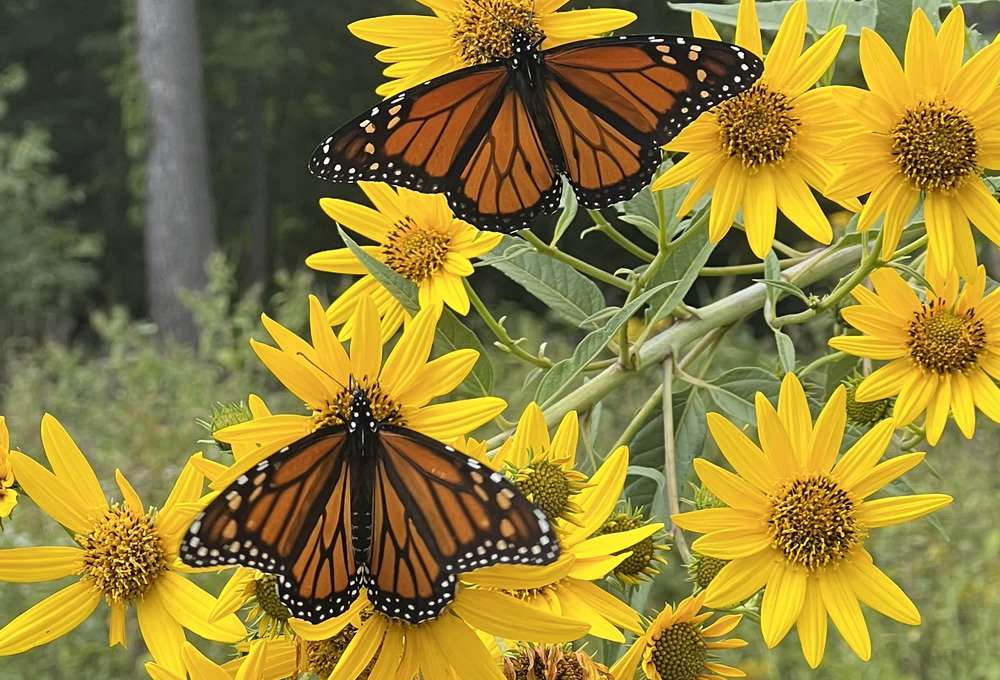
There is a lovely wetland wildflower meadow along a backstreet in our small Ozark town. The road cuts away from the main highway and skirts the edge of town along the base of a mountainside where the slope begins to flatten to form the White River Valley. Water seeps from underground and forms moist, rich meadows of an acre or more. Because I like to spot wildflowers in the wetland meadow I get off the highway to take this backstreet, away from the traffic, to ease home quietly, enjoying whatever nature presents itself in the ten minutes or so it takes to get through town. This wildflower meadow is one of the regular highlights. This time of year—September—the meadow is resplendent with moisture-loving wildflowers: swamp milkweed, beggarticks, great blue lobelia, boneset and the like. Interestingly, it is not dominated–as the other fields are–with nonnative species like tall fescue or Johnson grass or the rampant hairy buttercup (a sure sign of overgrazing). Unlike those other fields, this one is a bustling metropolis populated with pollinators of all kinds: butterflies, bees, wasps, beetles, flies, and hummingbirds. Paying a visit to this wildflower meadow in early fall is to witness the migration of monarch butterflies on their way to Central Mexico. We spot at least three on this visit. Perhaps these individuals were reared right here in this meadow, chewing the swamp milkweed leaves for both sustenance and for the protective poison—the cardiac glycosides (steroids) contained in the white sap of the milkweed leaves. Or did these monarchs fly, float, and sail down from some meadow in Minnesota or Manitoba and we are just a refueling station here on their way to Mexico? Sort of a monarch Exxon station. [/et_pb_text][et_pb_image src="https://demo1.plutopixels.com/wp-content/uploads/2021/12/monaarch-adult750x1000.jpg" alt="monaarch adult750x1000" title_text="monaarch adult750x1000" align="center" _builder_version="4.16" _module_preset="default" width="50%" width_tablet="75%" width_phone="75%" width_last_edited="on|phone" hover_enabled="0" global_colors_info="{}" sticky_enabled="0"][/et_pb_image][et_pb_image src="https://demo1.plutopixels.com/wp-content/uploads/2021/12/monarch-caterpillar665x1000.jpg" alt="monarch caterpillar" title_text="monarch caterpillar" align="center" _builder_version="4.16" _module_preset="default" width="50%" width_tablet="75%" width_phone="75%" width_last_edited="on|phone" global_colors_info="{}"][/et_pb_image][et_pb_text _builder_version="4.16" _module_preset="default" text_font="Rubik||||||||" text_orientation="justified" global_colors_info="{}"] Whoever owns this meadow has allowed it to grow up to its full potential of beauty and service to the pollinators, instead of grazing it heavily like many of the surrounding pastures in this valley. Of course, the value of a mature wildflower meadow goes far beyond that. For with pollinators come the birds that feed their young on those insects. And all these pollinated plants are producing wildflower and grass seeds which will sustain young birds for their own migration south as well as those who overwinter here. With so much of this countryside covered either in forest, tall fescue pasture–or asphalt–this wildflower meadow is an ecological paradise to the critters that find and utilize it. And let’s not forget the insects, mollusks, dragonflies, reptiles, amphibians, and mammals common to any wetland habitat, including the pond that it all empties into across the road. [/et_pb_text][et_pb_image src="https://demo1.plutopixels.com/wp-content/uploads/2021/12/wild-ageratum-and-bumble-bee750x1000.webp" alt="wild-ageratum-and-bumble-bee750x1000" title_text="wild-ageratum-and-bumble-bee750x1000" align="center" _builder_version="4.16" _module_preset="default" width="50%" width_tablet="75%" width_phone="75%" width_last_edited="on|phone" global_colors_info="{}"][/et_pb_image][et_pb_text _builder_version="4.17.6" _module_preset="default" text_font="Rubik||||||||" text_orientation="justified" global_colors_info="{}"] It all starts with the plants and how the land is managed. Start your own natural refueling station–learn how to plant a meadow here. Visit our seed shop here. [/et_pb_text][/et_pb_column][/et_pb_row][/et_pb_section]
